Wednesday, December 05, 2007

Top universities are from developed countries

The article below is written by Mansor Puteh and it represents his personal opinion. I reproduce here to share with everyone on this article, which I believe will allow us to think through the issues that he brings forth.
 
He writes this article based on his experience at Columbia University.
 
On the points he brought up, I would leave to everyone to judge. Only a point in the 2nd last paragraph, I personally do not agree with the definition of Professor and Associate Professor. At least what I see in Cornell is not what Mansor defined. Perhaps it could be due to different school/faculty. I am judging based on my experience at engineering college. Typically in Cornell, Associate Professor is given when a professor achieves his/her tenureship and usually after about 6 years, they will get full professorship. At least, that's what I understand.
 
Enjoy reading the article!
 
-----
Top world universities are from developed countries
 
Mansor Puteh

I was pleased that my university which was ranked 12th in the THES-QC listing of world class universities last year, rose a notch higher this year to number 11. It is the same university where Iranian president, Mahmoud Ahmedinejad was invited to speak at recently...and where Dustin Hoffman had acted at as a doctoral candidate in 'The Marathon Man' and Alfred Hitchcock was awarded an honorary doctorate in the early 1970s. And hopefully, soon this university will have the first and only person in the world to publish sixty (yes, sixty titles in Malay and English) books, simultaneously!

This is also the first university in America where the students had taken control of the university administration to protest against the American involvement in the protracted Vietnam War in the 1960s, which snowballed into a national pastime with students at other universities, taking their own initiative to demonstrate against the War which culminated in the killing by the army of some students at Kent State University at Wounded Knee. The ultimate success of the student campaign was the withdrawal of American troops in the then South Vietnam, which saw the country that was split into two merging into one Republic of Vietnam, which also saw the collapse of the 'domino theory'.

I would like to share my experience with those who are interested to discuss the issue of why Malaysian universities had failed to make it to the top 200 universities in the world, and will never make it to this list, ever. It is based purely from personal experience having studied at Columbia University in New York City.

My first question is: Just which universities does the ministry of higher education (MOHE) in Malaysia want to knock off from the list so some of our universities can replace them? All of them are well-established academic institutions that we have on many occasions sent our students and academic staff to study at. Yet, I have not heard of anyone from those universities that had been sent to study at any of our universities. And they have always strived to achieve excellence, while the Malaysian univesities only now hears the word, 'excellence' when in the past they had neglected to fully understand what it means, because they were busy churning out graduates.

This proves that we have a need to learn from them, but they do not have anything to learn from us, because what our universities know, were mostly from them! Their libraries have all the books that all the libraries of our universities have; and we have just a fraction of what their libraries have. The largest library in any university in Malaysia has a few hundred thousand titles of books; whereas the Harvard Library has six million in all languages and still counting.

I am happy to say that one of my books is kept in it, too, for which they acknowledged receipt after I had donated a copy to them on my last trip to their campus. They spend more money acquiring new titles every year, while our universities spend money on refurbishing their buildings including pavements, which change in shape and design every year, probably to suit to the tastes of the vice-chancellors or other senior administrators.

The top universities do not blow their own horns or organize shows, except for their commencements or graduation ceremonies which are held simply in the park and without much fanfare, with the students not being handed the scrolls individually, while ours are turned into a circus with lengthy speeches and a parade of the university staff. Their graduation gowns are simple while ours are so gaudy with unusually expensive 'songket' motifs that could pass for wedding costumes worn by Malay bridegrooms or characters in some 'bangsawan' plays, and not serious intellectuals.

To tell you the truth, I did not find the essay written by the minister of higher education, Mustapha Muhammed that was published in the Sunday Star, on why Malaysian universities could not make it to the list to be extraordinary. On the contrary, I can say it even lacks substance as his views are commonplace and downright boring because they are predictable. The Sunday Star only decided to publish his essay because of his stature and not necessarily because it was a brilliant piece of work.

And if anyone else has failed to notice, I would like to point to this one glaring fact; that all the universities in this top 200 bracket are those from countries that we generally describe as developed or whose economies are advanced such as America, England, Europe, Japan, South Korea, China, Singapore, Australia and New Zealand. All the universities in this bracket were prominent in their respective countries for a long time even before the THES-QC list was first announced few years ago. And as their countries and economies continued to develop, their status rose as they tried to meet with the demands of their expanding industries in order to provide the manpower needed for the continued growth of these strategic industries.

The problem they had was the fact that they were innovative countries which introduced a host of scientific and technological wonders that they could not find elsewhere but had to develop themselves. Whereas, in Malaysia, which is just happy to be a mere consumer-oriented country whose economy is largely dependent on what the others produce and create; there is no urgent need for us to be creative or research on anything since everything that we need is available to be picked from the shelves.

Yes, we have a small group of creative people, but they are also not exceptional or original, but copycat; especially those working in film, television, theater and the arts and advertising industry. We are only excited to be the first in the region or Asia to be able to bring into the country from abroad any technological wonder, without having to think hard enough to create them ourselves, to meet with our own special needs. In the end we have become extensions to the economies of the west and other developed countries.

We cannot expect to find any university from the lesser developed or poor countries to make the list. They are happy to be able to give university level education to their own students in order that they did not have to spend too much on them if they have to be sent abroad. This is their only function, and it is not to encourage it students to excel in education.

There are reasons why only universities in such countries could make it to the top 200 bracket while those which are in countries in the lesser developed or developing will find it very difficult to make the grade and they are not like those that the others including Mustapha had offered. It is not true that for a university to attain the world class status it has to have instructors or professors who have doctorate degrees, and who had conducted serious researches or published them in serious academic journals.

So I wonder what sort of research can our university professors and researchers do considering that the economic development of the country on the whole does not require any serious research to be conducted at all, and all the findings that we need are being provided free by researchers and scientists or experts from outside of the country? We have not yet got anyone to conduct a serious study on why there is racial division in this country to start with. All the views we have on the matter are given off-the-cuffs and based on general observations.

We, as a country, are mere consumers or copycats of ideas and findings that have been put on the shelves and sold in the markets of academia. I personally do not see how could we compete with the researchers at the top world class universities, and force our university lecturers and scientists to conduct researches just so that we can get them to discover something unusual, that their counterparts elsewhere had not managed to do before and to get them published in serious and prestigious international academic journals.

This would be very difficult to do considering that most of our university lecturers are arm-chair experts who conduct their researches in the comfort of the libraries and not in the fields. No wonder most of them can only spout second-hand ideas on anything including space technology, with our spaceman sounding like a parrot, having spouted nothing original that can be engraved in stone, let alone gold. And our politicians, NGO leaders, academicians, economists, sociologists, psychologists, philosophers and idealists, too, are sounding like parrots with no original views on anything.

At one time, the president of Harvard was an economist who only had a master's degree. I am sure there were many others at the university who had more impressive academic backgrounds but none of them were chosen to fill the post that was vacant then. The reason being these professors are supposed to be instructors and not administrators, and university administrators are not supposed to pretend to be experts in any chosen field, although there are few university presidents who also teach.

The co-deans or co-chairmen of the film division I was studying at were professionals with one having a doctorate and the other a Hollywood film director who had won two Oscars for best director. And all the instructors did not come to work from nine to five everyday; they only came to the film division at the school of the arts, when they have classes to attend to. Here, all university lecturers are expected to be on the campus everyday, regardless of whether they have classes to give or not.

And most of the top ranking universities are those that have small student population with Dartmouth College and Brown Universities having less than eight thousand students. Columbia and Harvard only have a student population of around 20,000 students each. And the campuses are not huge but compact so that the schools are close to each other. Dartmouth College and Massachusetts Institute of Technology (MIT) do not wish to change the names to 'university' yet they are able to offer degrees up to the doctorate level. In Malaysia, all institutions of higher learning yearn to be called a 'university' or at least a 'university college' with one private institution deliberately spelling the word 'college' in a small size to enhance the other word, 'university'.

I have a few other observations to make on my experience studying at Columbia for three years, which point to the attitude of the administrators, especially the vice-chancellors or presidents of our universities and the deans, and they way they often conduct themselves in public, which is mostly to show off their stature and not necessarily intelligence or expertise.

Throughout the period I was on campus, I did not see the president of the university or knew how he looked like. I only knew his name as Michael Sovern from the university catalogue. I did not read any speech that he might have read anywhere, or seen his photo in the college paper called 'The Columbia Spectator'. And he did not go around the campus to show his face and try to act important. Least of all, he did not give his personal views on anything to the media or wrote a column like many of our vice-chancellors do as a habit who would abuse their university facilities by using their university email addresses for personal and private businesses. He was not described as Professor Dr. Michael Sovern and all the academic titles that he had mentioned and repeated at any chance. He was just Mr Sovern, who drove his own car to work. And when the university authorities decided to auction his official car, I was told the market price was only US$2,000. And it was not even a luxury car.

Some of my professors went to work by commuting in the train, while the others preferred to cycle because it is their business to be with the public. One of my professors posed with his bicycle and wearing short pants in the university website, looking unpretentious; whereas in Malaysia, his counterparts would don the university graduation robes and standing in front of rows of books trying to look like serious academicians.

Yes, at Columbia, the university professors are called simply 'instructors' although their status is professor and the faculties are sometimes called 'schools'. They did not believe in using big words such as faculty. And the School of Journalism at Columbia is the one that gives away the Pulitzer Prizes for journalism each year. These are considered the most prestigious awards for journalism in the world.

And throughout America, those who teach full-time are called professors even though they may not have doctorate degrees, while those who teach part-time are associate professors. Adjunct professors are mostly retired people or those from the industry who teach occasionally like the adjunct professor I had who was 80 years and had been a screenwriter in Hollywood during the Silent Era.

One of my instructors, an associate professor, taught film editing, won an Emmy for best editing for a documentary yet, the next day when he returned to work, no one took notice of what he had achieved the night before, and there was no celebration and definitely no mention in the college papers. He only had a bachelor's degree, as most of my other instructors who also had master's degree.

Korat Sea Games 2007 (4th Dec 2007)

Today, our women soccer performed humiliatingly. Lost 0-5 to Myanmar. That's a bad performance. Perhaps our soccer team should have stayed at home and practice more.

Tomorrow, our men soccer team would fight against Singapore and if the final results is anything less than a win and Laos do not beat Vietnam, we can pack our bags too, even before Sea Games is officially launched.

For women's table tennis, we beat Myanmar 3-0, whereas our men team lost 0-3 to Indonesia. This is their 2nd loss already.

Do come back for daily updates.

Cost of Living & Salary Across Nations

Obtained this article on Cost of Living & Salary Across Nations by a fellow Mensa member.

The first one is on Salary Increase in 2007 across country and region. The link is here by ECA-International.com .

In the article, Asian workers are said to be getting the highest real salary increase (after minus inflation) for 2007. It is said that the real salary increase would be 50% higher than in 2006. Would fellow Malaysians agree on this? Not many might agree. Is this real? Is this perception? Is inflation only hitting Malaysia? I don't think so, especially with the oil prices skyrocketing.

Singapore Senior Managers show a real salary increase of 10%. That's quite significant. Malaysia ranks overall no. 8 in terms of real salary increase, just behind India, Indonesia, China, Phillipines, Thailand, Slovakia and Korea. Singapore ranks no. 12.

The other article focuses on Cost of Living. You can access it here at ECA-International.com .

For this, we see KL ranks as one of the cheapest cities to live in. In the world, it is the 197th most expensive city to live, and rank much cheaper compared to cities like Singapore 122th, Jakarta 153rd, Bangkok 168th, Manila 191st and Hanoi 195th.

So, we are like the 6th most expensive ASEAN city, although we should be no. 2 or so.

Business Week's Asia Young Entrepreneurs

A friend of mine, Chia Yee, shared on this article on Asia's 25 Young Entrepreneurs. This is definitely impactful, especially when we get to see young Asians, who are now successful entrepreneurs. We might be just peers, but they have successful broken through and be known. A lot of them might have put in a lot of hard work to reach there, with ingenuity idea and efforts.

To reach the article, do go to Business Week

Click on the profile of the 25 entrepreneurs. Those are motivating!

Tuesday, December 04, 2007

CIMB to sells its HQ and then leases back

CIMB decides to capitalize on the high property price these days, to sell off its Menara Bumiputera Commerce, which is scheduled to be ready by end of 2008.

The price for that 39 storey building is very good at RM460 million or RM730 per square foot. The purchaser is Pelaburan Hartanah Bumiputera Berhad (PHBB).

CIMB would then lease back the HQ for 10 years at a undisclosed amount.

The HQ is currently being constructed by IJM.

For full news, read from Forbes

NTT Docomo and KT Freetel to buy 33% stake in U Mobile

U Mobile, our latest mobile company, which would launch 3G services in March 2008, has just been injected a USD200 Million investment by Japan's giant of NTT Docomo and South Korea's KT Freetel. It would be a USD100 Million investment by each of these two investors, where each of them would have 16.5% stake in U Mobile.

This would definitely bring upon an interesting fight for our telco market. Currently, with the Norwegian impact in our DiGi and a potential Vodafone purchase of our Celcom, it would be interesting to have this Japanese and Korean involvement.

For full news, go to here

Genting has purchased 9.4% stake of Rank

Genting Berhad purchased a 9.4% stake in Rank Group Plc, the second largest casino and bingo company in UK. This definitely continues an aggressive expansion by Genting. Justin Leong declined to comment in an interview by Bloomberg.

With Genting's purchase, Rank's stock price went up 8.7%, making it to be 426.7 Million Pounds, which is close to RM3 Billion.

For full news, read here in Bloomberg

Li Ka-Shing in talks to buy a stake in facebook

Facebook,a social networking site that was started in Harvard a few years back, seems to catch the attention of Li Ka-Shing, one of the richest guys in Asia. He is reported to be interested to buy a small stake in facebook. This is after Microsoft investment of USD240 Million.

Li Ka-Shing is interested to pump in USD60 Million.

To read the reports, go to The Wall Street Journal

Sea Games Update (3rd Dec 2007)

Today, our football team went down to play, and finally they managed to give a good display of themselves. 4-0 win over Laos, means that we won't suffer the humiliation that Singapore went through 2 days ago, when they were held 0-0 by Laos.

Singapore beat Vietnam 3-2, and this practically threw Group B into open.

Current Standings are:-

Singapore 1 Win 1 Draw, total goals (3-2), 4 points
Malaysia 1 Win 1 Lose, total goals (5-3), 3 points
Vietnam 1 Win 1 Lose, total goals (5-4), 3 points
Laos, 1 Draw 1 Lose, total goals (0-4), 1 point

Final game:-
Malaysia vs Singapore
Vietnam vs Laos

Assume that the form book is not upsetted, Vietnam would beat Laos, and this means that for Malaysia to qualify for semi-final, we have no choice, but to beat Singapore.

The other event that we have Malaysian participation today is table tennis.

For men's team, we beat Laos 3-0, beat Myanmar 3-0, lost to Vietnam 0-3

For women's team, we lost to Singapore 0-3, beat Laos 3-0.

Our women's team will play Myanmar tomorrow, whereas our men team will play Indonesia.

Our skeet team, or rather even our shooting team is quite a let down this Sea Games. They end their campaign with just a mere 2 Golds 3 Silvers and 5 Bronze.

Malaysia got 1st point for Champions Trophy

After my earlier blog on Champions Trophy for Hockey in KL, Malaysia finally got a point today.

After trailing 0-2 to Pakistan for the first 56 minutes, Malaysia managed to replied Pakistan with 2 goals, from Chua Boon Huat on 56th minutes and Jiwa Mohan on the 64th minutes.

Finally, we got our 1st point.

The other 3 matches tonight are:-
Korea 6 Netherland 2
Australia 1 Great Britain 0
Germany 4 Spain 1

To catch up with the results, go to Wikipedia!

Malaysia Sudoku Society Inaugural AGM

A plus for Malaysia Sudoku Society Inaugural AGM

----
<<<<< Are you a Sudoku fan? >>>>>

<<< Do you like solving Sudoku? >>>


Announcing the formation of the

MALAYSIA SUDOKU SOCIETY


Come and join us at our Inaugural Annual General Meeting.

Be a founding member of the society!

Meet many other Sudoku enthusiasts!!


Date : 15th Dec 2007 (Sat)

Time : 3:00 ~ 4:30pm

Venue : Auditorium 2, Pusat Sains Negara, Bukit Kiara

(Registration of new members will take place between 2 to 3pm)


You may sign up as a member of the Society before 3pm,

and thereafter take part in the Inaugural AGM.

Agenda includes voting in the National Committee 2008,

and discussion of future plans and activities.


Entrance Fee : RM30 (one time payment)

Annual Subscription : RM20 per year


+ + + + + + + + + + + + + + + + + + + + + + + + + + + + + + + +

Special side event immediately after the AGM…

Talk by renowned Sudoku author Mr. Jeff Keow on

“5-Star Sudoku Solving Made Easy”

+ + + + + + + + + + + + + + + + + + + + + + + + + + + + + + + +


For more information please contact

Protem Secretary Mr. Lee @ 012-2341492

Protem Treasurer Mr. Wong @ 012-3853461

Protem Chairman En. Ismail @ 016-2242020

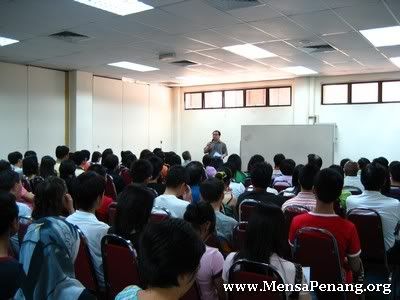
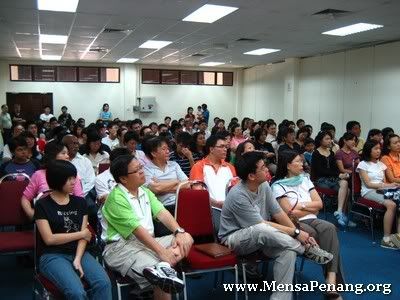
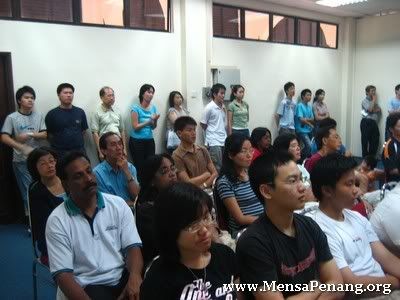
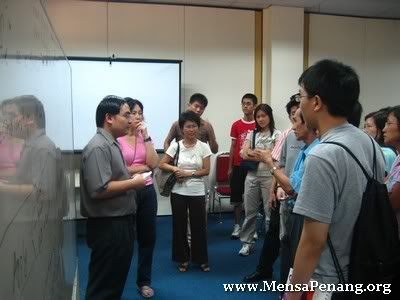
Photos from Scholarship Talks in Penang

Thanks Krista for the photos. These are some of the photos taken during the Scholarship Talks in Penang.

Photo Sharing and Video Hosting at Photobucket

Photo showing the crowd who came all the way to attend. I know there are some who came from Ipoh, Sungai Petani etc.

Photo Sharing and Video Hosting at Photobucket

Photo taken from the front instead :)

Photo Sharing and Video Hosting at Photobucket

Some actually had to stand throughout the talk. Really appreciate their spirit!

Photo Sharing and Video Hosting at Photobucket

Ending Q&A.

Thanks again to Mensa Penang for having me. After all, I joined Mensa in Penang back in April 1996, a good 11 years ago.

Monday, December 03, 2007

CSP Blogs by a CSP8 participant

For those of you who have read my blog earlier on the 9th China Synergy Programme for Outstanding Youth, hope that you would really apply for it!

I have come across a friend of mine, a fellow ReCom member (nick: bp_ffei), who has blogged extensively on his experience in CSP8. Although it is 3 years apart from mine, the experience is more or less the same.

So, for those of you who can't decide, do check this out!

Part 1
Part 2
Part 3
Part 4
Part 5
Part 6
Part 7

24th Korat Sea Games

With the curtain of Sea Games going to be raised soon, can our national contingent deliver the gold needed? We are targeting 64 golds, and now with 31 golds from shotting already being granted, we are only at 2 gold medals, way behind Thailand, Singapore and Vietnam. Can the Malaysian Tigers bite back? Can we fight back?

The Official Sea Games website is here . Would try to share the updates here daily, as I am a very keen sports follower, especially on sports concerning Malaysia.

Lets wish our national contingent, Malaysia Boleh!

Chong Wei lost in final to Lin Dan for Hong Kong Open

Chong Wei lost to Lin Dan in the final of Hong Kong Open, one of the Super Series for Badminton. He won the first set 21-9, but eventually lost to his nemesis, Lin Dan 15-21 15-21.

Chong Wei still has a lot of room to work on to improve. We really hope that Chong Wei could bring us the cheer from Beijing next year. Or may be from Mew Choo? Kien Keat-Boon Heong? or other players?

After many editions of Olympics, we are still waiting for our first shine of gold medal. Can badminton deliver it? Or we need other sports to do so?

Champions Trophy - Malaysia failed to register 1st win

After 2 solid games against Australia and Netherlands, we would expect that our National Team would be able to win against a winless Britain.

But again, we let down ourselves, we failed to register the win when it mattered most. We lost 2-3, with the Britain knocked in the winner due to our defensive error in the 66th minute.

For the full results report, go to here

3 Lives lost in LIMA Practice

Langkawi International Maritime and Aerospace (LIMA) claimed 3 lives today, when 3 paratroopers were blown by the strong Eastern wind, and they were blown 200m off the course and fell down 300m onto the sea off Pantai Cenang. They were doing practice before LIMA. That is definitely a tragedy that happened, and this should have been able to be avoided with greater precaution.

Condolence to the 3 families of the victim.

LIMA has definitely improved by leaps and bounds every year and this year, many of the top notch companies, will be around, but unfortunately this incident happens. Hopefully, it won't dampen the spirit of the event.

MIT Open Courseware for High School

Got this link from a friend, who is also a fellow ReCom member. He has always been resourceful and able to find many interesting resources, but always would like to stay anonymous.

MIT has prepared Open Courseware for High School students and it is also very useful for those who want to use it to prepare for AP exam.

Do make full use of it MIT Open Courseware for High School

Sunday, December 02, 2007

Should Residential Schools be Opened?

Read about this in Education Malaysia blog . The original source of this article is at NST by Chok Suat Ling.

I would say that this article is definitely interesting. Kian Ming from EducationMalaysia was quoted quite a bit, as well as YB Wee Ka Siong from MCA.

Should residential schools be opened to everyone? Would this bring more benefit or harm to our socio-economy? Would this help to restructure our country? Would this mean that racial integration would be improved? Would this attract the students to attend?

In my opinion, this opening up of residential schools would need to take several steps. First thing is to really make the opening up of matriculation and MRSM being implemented properly, and be attractive to all students. As mentioned in the article in NST, the take-up by non-bumiputera students have dwindled. So, we should really do some analysis on what goes wrong and how to make it more attractive. When that happens and there is a much better representation of non-bumiputera in MRSM and matriculation, then there could be more efforts to open up for other residential schools.

I would say that this opening up would benefit our country elite students. The students would enjoy mingling with one another and learn from one another. This would break the problem of racial dis-integration. It might take years, before the main problem is solved, but the earlier we get down to such issues, the more chances we have to solve this problem.

We need to efforts of everyone to do so. It must not be half-hearted efforts from any party. Government needs to take the first step, but parents and students need to accept the policy with open arm. There should be more trust between one another. After all, this is on education and we are talking about all-round education.

The teachers at those various residential schools, MRSM and matriculation should be diverse as well. It would be great if the students could be taught by teachers from all races. That would by itself set an example for the students.

The efforts would be tough to do all this, but as our Education Minister said so, he would do whatever necessary, to bring our Education System to be top notch. So, if this method could work, why not?

Below is the full article from NST reproduced:-

----

Opinion: Unity may reside in boarding schools
By : CHOK SUAT LING

Residential schools could play a valuable role in national integration if they were open to all Malaysians regardless of race, writes CHOK SUAT LING.
NURUL Nadia Mohd Izmir spent a large part of her growing years in Sekolah Seri Puteri, a prestigious all-girl residential school.

She recalls the close friendships forged with classmates with whom she not only studied but shared rooms, clothes, food, gossip and girl stuff. Nurul remains in touch with her classmates from SSP, as the school in Cyberjaya is popularly known, even though all have embarked on different pursuits. She herself is now pursuing her degree in Universiti Teknologi Mara.

Although her formative years were spent in a school with an all-Malay student population, Nurul's large network of friends is multiracial. "I have many good Chinese and Indian friends too and I am as close to them as my SSP-mates. To me, everyone is the same irrespective of racial, cultural or religious background."

Nurul gives the lie to the perception that those not exposed to other races at a young age are likely to negatively stereotype people they have never known as individuals. And while some government and private boarding schools are open to all ethnic groups, most are not.
Sultan of Perak Sultan Azlan Shah recently observed that the country would benefit from residential schools reflecting a more "complete" composition of Malaysian society. He noted that it was untenable for multicultural Malaysia to segregate schoolchildren according to ethnicity or religion. "The education policy and the implementation of its agendas must make the fostering of religious and racial ties a priority," he said.

Professor Dr Rosnani Hash-im of International Islamic University Malaysia's Institute of Education agrees that schools comprising one ethnic group are not conducive to national integration in the long run.

"For these schools, civics and citizenship education, even if offered in the curriculum, are just academic subjects for examination rather than a practical exercise in deliberation and seeking consensus as a community of Malaysians. There is no opportunity to hear the views of the 'other'."

Rosnani stresses, however, that even if there is going to be open admission for non-Malays, the raison d'etre of residential schools - to help those from the lower socio-economic strata - should continue to be applied.

She points out that private independent Chinese secondary schools would also benefit from having a more ethnically diverse student population, sensitising them to the cultures, traditions and concerns of all Malaysians. National-type Chinese primary schools, however, already have a relatively high non-Chinese enrolment. Of the more than 640,000 students enrolled, almost one-tenth are non-Chinese.

Ong Kian Ming, who runs the education weblog educationmalaysia.blogspot.com, notes that it is not only important that children in residential schools interact with those of other races, but also how they are educated there.

He thinks it unfair to group all residential schools under one general banner. "The Malay College Kuala Kangsar (MCKK), for instance, although exclusively Malay, is also a place where students are taught to think critically and challenge themselves," he says.

"I have not met many MCKK students who are narrow-minded and cannot or do not want to interact with the other races. But then MCKK students come from middle- to upper-class Malay families in urban areas and go to top universities abroad, which provides them the opportunity to interact with other races."

Some argue that opening up residential schools to non-Malays would not work if the parents and students themselves are not interested. Mara junior science colleges (MRSM) set aside 10 per cent of places for non-Bumiputera students, but fewer than 100 non-Bumiputera students are enrolled in the more than 30 MRSM around the country.

"When the policy was introduced in 2002, the response was quite good but the numbers slowly dwindled," reports MCA education bureau chief Dr Wee Ka Siong. At first, non-Bumiputera students were placed in five colleges, but now they are spread among all 30, keeping their numbers in each college negligibly low.

"They are greatly outnumbered in these colleges," says Wee.

"Non-Bumiputera parents are not comfortable sending their children where they can feel like outsiders. For instance, during prayer times or when there are religious programmes, the non-Malay students will be left to their own devices."

Wee is sure that if the 10 per cent quota is removed, more non-Bumiputera students would enrol. "All residential schools should open their doors to non-Malays. We need to force students to mingle for the sake of unity. When they study and play together, meaningful friendships can be forged."

He admits it won't be easy. "There will inevitably be unhappiness. Even if it were made policy, the schools may not be receptive."

Ong suggests establishing new residential schools enrolling students of all races, along the lines of Kolej Yayasan UEM or KYUEM, but at secondary school level. KYUEM, owned by Yayasan UEM and part of the UEM Group, is a fully residential college modelled on top British boarding schools.

However, Jasmine Adaickalam, a service consultant with the MIC's Yayasan Strategik Sosial, cautions that it won't be enough to "just put everyone together and say 'this is it'".

"We should learn about diversity in a mutually appreciative environment. In India, where I am from, all students learn about Islam, Hinduism and Christianity. Only when we really know and understand each other's beliefs and value systems would we be able to appreciate one another."

Rosnani sees a single national school system as the best way to unity. "We need to develop a single system that caters for the needs of all ethnic groups - mother-tongue languages, traditions and cultures, and Arabic for Muslims," she says.

"I believe having a single school session which involves prolonging school hours and providing school lunch for needy students would help achieve this."

For Nurul, it is simpler. "Family upbringing is the most important thing," she says. "My parents lead by example. They have close friends of all races, and from childhood encouraged me to do the same."
-----

Sime Darby - Synergy Drive

Sime Darby was relaunched again yesterday and its launching really pushed up our KLCI index. It crossed 1400 for a moment, hitting a high of 1408, before retreating back below 1400.

That's great momentum. Now, Bursa Malaysia has the world's largest plantation company, with the total market capitalization of RM66 Billion (That's quite a bit, almost USD20 Billion).

Would this Sime Darby merger brings upon Synergy? Just like the name of Synergy Drive? Would Tun Musa Hitem be able to rejuvenate this stock?

Lets hope for the best!

Scholarships Talk in Penang

Thanks to the invitation from Mensa Penang, today, I had a chance to share with about 130 students and parents in Caring Society Complex in Penang on How to Apply for Scholarships to Study in U.S.

It is a great session and it is a great crowd. Thanks to Nic and Krista for organizing this and it is great to see PC Sim, Immediate Past Chairman of Mensa Penang there as well.

Covered various aspects during the session, from life being a student in U.S., various scholarships opportunities in Malaysia, especially on JPA, scholarships from Singapore and also those financial aids from U.S., and also some tips of applications.

Guess, the 2 hours were not really sufficient. So, a lot of things had to be rushed over. But guess, the attendees have a good sense of what was covered.

Seems a fruitful session!

9th China Synergy Programme for Outstanding Youth

Wow! It's CSP9 already. This program is called the 9th China Synergy Programme for Outstanding Youth. It is a 17-day trip to visit various parts of China (Hong Kong, Guangzhou, Xian, Beijing, Tianjin and Shanghai.) For this next trip, it is going to be held on 1st to 17th July, which is just a mere 3 weeks away from the official opening ceremony of Beijing Olympic Games.

For more info, go to China Synergy Programme's Website .

It is definitely a fantastic experience. I definitely have very vivid memories of the trip. You would get to experience many things that you would not imagine yourself having the opportunities to go through during normal visit.

Some of the main aspects during the trip.
a) You would get opportunities to rub shoulders with many of the top leaders in China and Hong Kong. In most cities, the mayor would be meeting you. For Hong Kong, I believe Donald Tsang would meet you and in Beijing, Jia QingLing will be meeting you. Those are the top leaders of those areas. In many cities, you would get to meet with many who are planning for the development of the cities.

b) Opportunities to visit those universities, be it those universities in Hong Kong, or in various parts of China, like Peking University, Tsinghua University, Shanghai Jiao Tong University, Fudan University etc.

c) Meet with those people in the industry. During my time, Baidu Founder met us, and during those days, Baidu has not yet hit IPO.

d) Last but not least, you would get to meet with about 200 very interesting, hyper active bunch of your peers from around the world. Those people would be traveling together with you and having fun with you!

e) And it is a really good tour of China, visit all the top places that many would want to go and visit.

And what you have to do is just to:-
a) Apply for admission (you would need to be ethnic Chinese, as well as being a student in a university (undergrad or postgrad) to apply).
b) Once you get offer of admission, you would need to pay USD200 (that's like RM675) for the 17-day all-expense paid trip.
c) You would need to get your own air tix to Hong Kong and back, as well as your visa to China.

That's all. The rest of the cost is sponsored.

Application deadline is 28th January 2008.

Many people have applied and gone there. Many of my friends have gone through the trip too.

So, do apply! It would be memorable. Do spread the words to others!

Friday, November 30, 2007

Global UGRAD Exchange Program

This is a great opportunity for those who are currently studying in universities in Malaysia and want to spend half a year or one year in U.S.
 
Just got this email from U.S. Embassy, that they will select 10 students for 1-year program and 10 students for 6-month program of Study in the USA: 2008 Global Undergraduate Exchange Program. 
 
The deadline of applications is 8th January 2008. To get the word document form, just email me.
 
========== 

STUDY IN THE USA!

2008 GLOBAL UNDERGRADUATE EXCHANGE PROGRAM

Looking for an enriching undergraduate experience in an American college or university?

The global UGRAD program provides scholarships for one semester or one academic year of U.S. study in a non-degree program. 

Successful applicants can expect an in-depth exposure to U.S. society, culture and academic institutions.  Participants will be enrolled full-time in undergraduate course-work with opportunities for ongoing interaction with U.S. faculty and student peers, and for exposure to U.S. academic and classroom culture. 

Courses on topics including academic research and writing, critical thinking, time management, note-taking, studying for and taking tests will be offered.

Students will be provided with opportunities to participate in up to ten hours of community service activities per semester.  Additionally, an internship will be offered to all academic-year participants during the program.  Internships will be related to each participant's field of study and/or career plans.  Upon completion of the program, participants are required to return to Malaysia and continue their studies.

ELIGIBILITY:

Scholarships will be granted to students who currently are enrolled in an undergraduate degree program in their home country, and who have completed their first, second, or third year of undergraduate study.

TO APPLY:

Please complete the application form attached and ensure that the application package reaches us by January 8, 2008.  The completed application package should include the application form, academic transcripts, letters of reference, and TOEFL score report.

All applications should be submitted to:

Global UGrad Program Coordinator
Public Affairs Section

U.S. Embassy

376 Jalan Tun Razak

50400 Kuala Lumpur

Deadline: 8th January 2008

Recent Demonstrations

Recently, our country, or at least, Kuala Lumpur, capital of Malaysia, has been plagued by several demonstrations. Is this healthy? What would this impact our country? Should we support these demonstrations? Do we, as common Malaysians believe in these demonstrations? Would these bring effects? Would this build harmony among Malaysians or create tension?

I am posing tons of questions for everyone to ponder. For me, I would like to choose the middle ground.

Being a common civilian, I definitely hope for a peaceful country, which means that I hope that there won't be any demonstration, which would affect people's life. KLCC and Ampang Park LRT has to be closed for several hours last Sunday due to Hindraf's demonstrations. There were lots of road blocks that caused a lot of discomfort to commoners.

Some might argue that those pre-emptive actions by government is not necessary. For me, I would say that a certain level of pre-emption should be carried out, but may be not at the extent that is being carried out today. Train stations could still be opened, and business goes on. Those who are involved in demonstrations should practice restraint and not resort to violence. I know majority are not violent, but these kind of activities are very prone to fights or tensions. We just need some very few people to cause that to happen.

On the demands or the reasons that cause the demonstrations, I would say that while it is good that we need to have those minority voices to be heard, I would prefer more suitable ways of handing over memorandum or ways to spread awareness. Being from Eastern culture, negotiation could be a better way. Engagement with our leaders, could be a way to solve the problems. While those demonstrators' hope is to bring attention to the problems, such action might affect our tourism significantly.

What is the middle point? What should we do in the long run?

Above just my two cents.

London Fish Tales

Today's lunch, Coreen treated me to London Fish Tales, the latest restaurant in KLCC 2nd Floor Food Court. It is the same chain as Manhattan Fish Market, Tony Roma's, Sushi Groove, Hainan Kopitiam etc.

I personally think that London Fish Tales is definitely very worthwhile, especially with the price and the size of the food. A very large portion of Pacific Dory Fillet (longer than 25 cm) that I took, with some fries, came at a price of RM9.90. This is a great price especially at KLCC.

Do try it out!

APPLE Call Warrants

Today, finally got to know that we only managed to get 10% of the total placements that we put in for OSK Apple Call Warrants. Seems that it is very overly subscribed. So, would definitely looking forward to the IPO day on 11th December.

Finally, I will be owning a little portion of a US Call Warrant.

Mensa Penang Scholarships Talk

Mensa Penang will be organizing a Scholarship to Study in U.S. talk on 1st December, Saturday, 2:30pm to 4:30pm at Caring Society Complex in Penang. I will be helping to share my experience for that seminar. If any of you are in Penang and are interested to attend, do hope to see you there!

Among the aspects that I will be speaking on would include:-
a) Life in U.S.
b) Scholarships available from Malaysia/Singapore to study in U.S. Universities
c) Scholarships/Financial aids from U.S. to study in U.S. Universities
d) Application tips for applying to study in U.S. Universities

For some of the scholarships information, you can visit:-
ReCom.org (The Worldwide Malaysian Students Network
Tinkosong.com
Malaysia-Scholarship.com

Good Luck!

Wednesday, November 28, 2007

The 1st National Youth Entrepreneur Convention 2008

YouthMalaysia.com will be organizing The 1st National Youth Entrepreneur Convention 2008 on 19th January 2008 (Saturday) at Putra World Trade Center .

It is to inspire and impact Malaysian youth community! There will be a lot of prominent figures to speak, especially many youth entrepreneurs.

Among the keynote speakers:-
1. YB Dato' Seri Azalina Othman Said, Minister of Youth and Sports
2. YB Datuk Ong Tee Keat, Deputy Minister of Higher Education
3. YB Dato' Liow Tiong Lai, Deputy Minister of Youth and Sports

Among the Youth Entrepreneurs:-
1. Mr. Joel Neoh Eu-Jin - Founder of YouthMalaysia.com and Winner of NTV7 The Firm
2. Mr. Kevin Zahri - Fitness Trainer and Business Owner
3. Mr. Timothy Tiah Ewe Tiam - Co-Founder of Nuffnang
4. Mr. Raj Ridvan - Co-founder & International Director of Science of Life 24/7
5. Mr. Kenny Sia - Blog owner of KennySia.com
6. Mr. Ng Khai Lee - Co-founder of TheCicak.com and Winner of KLUE Blue Chill Award
7. Ms. Xandria Ooi Xhan Tii - TV Host/Emcee/Journalist
8. Mr. Chris Tan Chur Pin - Proprietor of Chur Associates and Executive Secretary of SME International.
9. Mr. Kid Chan - Founder and Director of Kid Chan Studio
10. Ms. Oh Joo Nee - Founder of Lets' Dance Studio and Winner of Nescafe Kickstart TV Show
11. Mr. Kenny Goh Chee Ken - Co-founder and CEO of Macro Kiosk Berhad
12. Mr. Shahul Hameed Dawood - CEO of People Source Sdn Bhd

For full event details and sign ups, go to here

Open Letter by Kian Ming to Tok Pa

Ong Kian Ming, co-blogger of Education Malaysia and a PhD student at Duke University has written an open letter to Tok Pa, our Minister of Higher Education in Education Malaysia and Malaysiakini on our Higher Education Policy and ways to improve our local institutions of higher learning.

I would say that Kian Ming has brought up a number of interesting and valuable points for our Ministry of Higher Education to act. I definitely concur with Kian Ming that Tok Pa has taken the right step to focus on improving the quality of our institutions of higher learning, rather than blaming the ranking methodology. That's definitely a step ahead, and hopefully, we can get all the institutions of higher learning to work hard towards improvement.

The full letter by Kian Ming can be read here in Education Malaysia or in Malaysiakini

I reproduce it below:-

-----

Open letter to Tok Pa
Ong Kian Ming
Nov 27, 07

Dear Minister of Higher Education,

I was encouraged by your letter published in the Star on Nov 14, addressing the issue of our public universities falling out of THES top 200 list of universities in the world. I was encouraged because you did not dwell on the how changes in methodology used by QS, the company responsible for compiling the data, might have affected the ranking of Malaysian universities in the THES survey.

While understanding the technicalities of why our public universities have dropped off the top 200 list may be important to better understand the strengths and weaknesses of our public universities, I believe that from your many travels to top universities worldwide, you know that our public universities are very far from being anywhere close to the top 200 universities in the world, however measured.

I have also been encouraged by the way your ministry has been very focused in its approach to transform our public universities as specified by the National Higher Education Strategic Plan and the corresponding National Higher Education Action Plan 2007 - 2010. The goals set out in these plans are realistic and if achieved, will certainly make significant improvements to our public tertiary education system.

At the same time, I am aware that political considerations and restrictions can prevent even the best plans from being fulfilled and hinder a politician's ability to speak honestly. For example, you mentioned that: “Still, massification of higher education was the right choice for a young, developing country that had to ensure its citizens access to education and thus, a brighter future.”

Was the indiscriminate expansion of higher education necessary in the context of Malaysia? Is this not one of the reasons why there are currently a large number of unemployed and unemployable Malaysian graduates in the market, largely the result of them not being able to pick up the requisite skills to make themselves employable? Would an emphasis on vocational and technical education for those who are not academically-inclined have made more sense instead of pushing these students into courses which they have little interest in and is, at least, partly responsible for making some of them unemployable?

Was the practice of “awarding” and building universities in every state in Malaysia not a political tool for “rewarding” voters in these states? Did it not lead to quantity at the expense of decline in quality?

At the same time, I would guess that it was not possible for you to say that the “massification” of higher education in Malaysia went along with policies which prevented qualified Malaysian students from getting the courses of their choice.

This resulted in them leaving for universities overseas and less qualified candidates “flooding” the gates of our public universities. In addition, a large number of above average students were also awarded scholarships by the government and government-linked companies to study overseas, leaving our public universities almost denuded of top students.

I am also sure you realise that the “massification” of higher education in Malaysia not only decreased the quality of our students. The same phenomenon was taking place among the ranks of the faculty. Lecturers were promoted indiscriminately based on “know who” rather than “know how” and that promotion policies were also responsible for driving many qualified academics to universities overseas, leaving the ranks of many faculties relatively denuded.

The notion that a Malaysia public university can even be anywhere close to the top 200 universities in the world is somewhat laughable given that less than 50 percent of most faculties in our public universities have PhDs. While having a PhD is not necessarily a prerequisite for doing good research, it is an important indicator of proper training for good research, having worked and learned from experienced supervisors and completing a major piece of
research work.

Is it so surprising that our public universities have low peer review and citation scores when many members of the faculty are not trained to publish and produce cutting-edge research? When this is combined with a culture which does not reward publications and punish non-publication, it is no surprise that our faculty has and will continue to score low on peer review and citations per faculty.

How can you change this? I think the Ministry of Higher Education (MOHE) and public universities are already taking some steps to address this starting with the push to send more Malaysian faculty members overseas to complete their PhD. But even then, the process by which non-PhD holders currently lecturing in our public universities can obtain funding from the MOHE to do their PhDs overseas is still far from transparent.

From anecdotal evidence I've heard from some of our readers, the process is still very much driven by “know who” rather than “know how” and sadly, by racial quotas instead of by ability.

If this practice continues, I would not be surprised if the percentage of sponsored students obtaining their PhDs would be less than 50 percent, again leaving the MOHE in the quandary of not being able to achieve its 60 percent target of PhD holders by 2010.

While your strong words of inculcating a “publish or perish” culture is encouraging, it will have little “teeth” if it is not seriously implemented in our public universities. Our public university lecturers are almost “unfireable.” Hence, a threat of “publish or perish” is not seen as credible unless real action is taken.

Does this mean that you are willing to slowly “weed out” the non-performers in our public university system replacing them with highly motivated and better qualified academics? Only time will tell.

The road ahead is fraught with challenges, both internal and external. As events and trends in the world continue to develop and evolve, our public universities are in danger of being left behind. At the same time, internal political constraints and considerations make it even more difficult to change from within. Your job is not one which I envy and I applaud you for at least taking positive and concrete steps to effect change, hopefully at a substantive rather than a cosmetic level. But I fear that the restraints that is the Malaysian political system will eventually get the better of your good intentions, at great expense to our country.

-----

This article represents the opinion of Kian Ming.

Recommended Books by MCA

The following are few of the books recommended in Malaysian Chinese Association (MCA) website. MCA has played a very crucial roles in promoting lifelong learning among fellow Malaysians, especially among Chinese community. I have found the recommendations of the following few books been very apt.

The 5 recommended books are:-
1. The Making of the Malayan Constitution - Joseph M. Fernando
2. The Price of Peace: True Accounts of the Japanese Occupation - Foong Choon Hon
3. The New Villages in MalaysiaL The Journey Ahead - Lim Hin Fui and Fong Tian Yong
4. Tun Sir Tan Cheng Lock - MCA Publicity Bureau
5. Valley of Hope: The Sungai Buloh National Leprosy Center - Phang Siew Sia and Wong Chau Yin
6. God of the Earth - Ho Thean Fook

The links are at MCA Website

Call Warrants of US Share in Malaysia

Since Google call warrants have been launched in Malaysia, OSK is taking another steps to launch another two call warrants of U.S. shares in Bursa Malaysia. This allows Malaysians opportunities to own shares in U.S. markets, or rather rights to buy shares. The two latest U.S. call warrants to be launched are Apple and Exxonmobil.

This definitely shows that our market has been opening up. For the past few months, interesting counters have been launched in Malaysia and our market is now providing opportunities for Malaysians to own a piece of action for shares around the world. That gives us opportunities to really diversify our investments and also take on more higher risk investment.

Sunday, November 25, 2007

Malaysia Festival of the Mind II

Obtained the following in a Malaysia Mental Literacy Movement mailing list. It could be an interesting talk. For those of you who live near Kampar, you could check it out!

Don't forget to check out Malaysia Festival of the Mind II on 22nd and 23rd December at UTAR, Kampar campus too!


----
In conjunction with the Malaysia Festival of the Mind II on 22 & 23 December 2007, the Malaysia Mental Literacy Movement (MMLM), Kolej Tunku Abdul Rahman (KTAR) and Universiti Tunku Abdul Rahman (UTAR) are jointly organising a complimentary talk entitled ‘Face & Destiny: Understanding Yourself & Others’ conducted by Joey Yap.

We would like to cordially invite you to the complimentary talk. The details of the talk are as follows:
Date : 14 December 2007 (Friday)
Venue : Auditorium, KTAR Perak Branch Campus
Jalan Kolej, Taman Bandar Baru, 31900 Kampar, Perak.
Time : 5.00 pm – 6.00 pm

Please find the enclosed attachments pertaining to the talk. For more information, please visit www.utar.edu.my or contact us at 03-7625 0328.

Thank you.

Best wishes,
Secretariat
Malaysia Mental Literacy Movement (MMLM)

Bakri Musa's Aligning Private Aspirations with Public Good

Obtaining this article of Bakri Musa from a mailing list. I would say that the following article is definitely interesting, especially on various ways he brought up in paragraphs 13-15. Start counting the paragraphs, or better still, read the articles.

Several points brought up, like giving scholarships to Malaysians who manage to get into elite universities, without restricting on courses of study, is definitely a fantastic suggestion. Besides that, the suggestion to provide preferential treatment to companies that reflect the racial structure of Malaysia is interesting. I doubt on whether this could be efficiently operated though, although it seems an interesting and fantastic concept.

Do enjoy reading
----
Aligning Private Aspirations with Public Good

M. Bakri Musa

Bravo to Negri Sembilan Mentri Besar Mohamad Hasan! In awarding RM25,000 to each first-class honors graduate of local public universities, he clearly demonstrated where the priorities should be. He went further and forgave the students’ loans if they were given by his state agency.

To put that cost in perspective, at a total of about RM300,000 it is less than the inflated cost of one corrupt school laboratory construction project. Yet the benefit far exceeds that of any school computer lab, even if it were well built. As a bonus, unlike a poorly built building, this award program poses no danger to anyone.

Malay leaders, especially those in UMNO, continually lament on the generally backward status of our people despite decades of ever increasingly generous preferential treatment. Unfortunately that is all they are capable of doing – lamenting. Occasionally a bright leader might emerge who in a show of bravado would chastise and upbraid us by degrading our cultural heritage and questioning our biological endowment.

Only very rarely would a leader like Mohamad Hasan do something right, like having an appropriate mechanism in place and aligning the incentive system that would encourage the development of those qualities that we desire in our people. My complimenting Hasan would I hope encourage other leaders to follow his fine example.

Mechanism Design Theory

It is instructive that this year’s Nobel Prize in Economics was awarded to three economists whose collective intellectual contributions under the rubric of “Mechanism Design Theory” help us understand better the real world in which we humans interact. Their insights could help us create our own institutions that would encourage the development of desirable behaviors and traits in our people by realigning our private and public incentives accordingly.

To purist disciples of Adam Smith, the open marketplace, guided only by the omnipresent “invisible hand” that would smack those who make the wrong decisions and pat those who had the right ones, is the best mechanism to ensure this. However we all know that competition – and thus the marketplace – is hardly ever “pure.” Unrestrained, the human tendency is to collude and conspire. Unrestrained “pure” capitalism would produce only conscienceless capitalists of Dickens’s era. We still see those characters today, in such places as China, resulting in millions of children being poisoned by their cheap but dangerous toys.

Malaysia too, under its “world’s happiest Prime Minister” Tunku Abdul Rahman, was enamored with unrestrained free enterprise, at least as understood by him. The result was disastrous, and no sane Malaysian would want a repeat of the May 1969 tragedy.

To economists of that era, like the eminent Ungku Aziz, the problem of poverty, specifically Malay poverty, would be solved if only we could remove the stranglehold of the monopolists and monopsonists. Broke them we did, with Pernas, Petronas, and other ‘Nases in the form of the various government-linked corporations. We also legitimized the “natural monopolies” in providing essential public services like utilities.

Unfortunately, those monopolists, whether state-sponsored or guided by individual greed, behave essentially in the same manner. Meaning, the public is ill served by them. It turned out that nothing improves service as much as competition. This applies to air travel as well as healthcare. Witness the improvement in air travel with the approval of Air Asia to compete with government-owned Malaysia Airlines. The healthcare of Malaysians is also much better served with the presence of a vibrant profit-making private sector.

Preference Falsification

Mechanism design theorists recognize the world as it is and take humans as we are. That is, we are neither saints nor satans and that we respond to incentives in what we believe to be in our best self interests, our public declarations notwithstanding. What we consider as incentives however may vary. To capitalists, interest income is a powerful incentive to save; to devout Muslims, an invitation to a life of sin and thus a definite disincentive!

A more monumental problem is that what we profess publicly may at times be at variance to what we believe or want privately, a phenomenon economist Timur Kuran refers to in his book, Private Truths, Public Lies, as “preference falsification.” This is the greatest barrier to formulating sound public policy.

The insight of mechanism design theory is in implicitly recognizing this and designing institutions that would best align public and private goals. This could be reconciling the seller wanting to maximize his profit and the buyer demanding the cheapest product; to universities upholding meritocracy and admitting only “top” students over the demands of influential alumni in “legacy” admissions favoring their children. On a broader public order, it could be the government wanting the greatest revenue from its broadwave spectrum to making sure that the public is well served.

In my book An Education System Worthy of Malaysia, I suggest ways how we could encourage excellence among our students by guaranteeing them scholarships when they manage to secure admissions to elite universities of the world. Not only that, we would give them the freedom to choose whatever field of study they wish in order to pursue their dreams. They and Malaysia would benefit from such a policy, a congruence of public policy and private aspiration.

In a later book, Towards A Competitive Malaysia, I suggested that public contracts be preferentially awarded to companies whose work force reflects the greater Malaysian society regardless whether the company is foreign or locally owned. It matters not whether the company is a subsidiary of Temasek or Guandong State Development Corporation, if its workforce reflects the greater Malaysian society, which in a practical sense means enough Malays at all levels, it would get preferential treatment.

This would align the public goals of attracting foreign investments, getting the best contractors, and integrating the private sector work force with the private one of encouraging Malays to pursue practical subjects so as to make them employable. We thus effectively align incentives such that private gains are compatible with the pubic good, or to use the language of the mechanism design theory, “incentive compatibility.”

Locally, our leaders may want to groom “glokal” Malays, but they unhesitatingly “protect” their children and even in-laws, a clash of stated public goals with individual’s private agenda! By rewardingly generously those who excel scholastically, Mohamad Hasan is attempting to reconcile public policy with private aspirations by designing his own mechanism or institution albeit on a very tiny scale.

------
This article is by Bakri Musa and it does not represent my opinion, or whether my agreement/disagreement with what was brought up.

David & Er Fei's Wedding!

Congratulations to David Chuah and Quah Er Fei for their wedding yesterday. They have definitely decorated their wedding ceremony very interestingly, with garden setting. My first wedding in a garden. They put in a lot of efforts in making the decorations look very striking in their wedding ceremony! They imported the flowers from Singapore, with a bouquet each for each table. With wine on each table, as well as bottomless drink, from plain water, soft drink, orange juice, beer, wine to hard liquor. Everything is complete. They even put a bunch of grapes on each table. We even wondered whether it was real and it was real!

The ceremony attracted guests from far and near, with some even from Canada and Australia. That just shows how wide range their friends are. It is a wedding of 2 Accenturians, attended by Beng Choon (Country Managing Director) and many other partners, senior managers, managers, consultants and analysts. It is a gathering of Accenturians!

They did some powerpoint slides, in full Accenture spirits and they found each other within the firm as well.

Instead of the usual numbers on the tables, they name each tables by wine or aeroplanes. That is definitely unique and can see people going around looking for their wine/aeroplane names.

Thursday, November 22, 2007

Letter by Mark Disney on Local Universities

This is a letter by Mark Disney to Malaysiakini. The link is here . This letter offers a different perspectives on the ranking and it offers several constructive suggestions on how we can improve our local institutions of higher learning.

Without reproducing the entire letter, I am quoting the suggestions on how to improve our local institutions from the letter.

To read in full, do refer to the link above.

-----
Varsity rankings are like beauty contests
Mark Disney


We can all play this game, but to kick off, I offer a few feasible steps to improvement:

Mindset changes

This must start at the undergraduate level where restrictive cultural mindsets need shaking up. Postgraduate work, research and development, commercialisation and publication levels all need attention but this is a somewhat separate issue from undergraduate teaching, which has to be a lot livelier and more student-centred.


Recruit the best

Ensure that our top students wish to and are able to enter the IPTAs and that our best brains remain in Malaysia to teach them. This means changes to the current admissions policies based solely on STPM and matriculation – how about A' Levels, UEC, SDAM or SAT? It also means cutting back on the number of government-sponsored overseas students, at least at undergraduate level.

If our brightest and best-connected (calling all politicians, corporate figures and senior civil servants) went to government universities, then standards would have to improve. Currently, everyone bemoans the fact that our universities are race-obsessed but this is only one schism. What people seem to forget is that they are socially and economically divided too, with most well-to-do parents from all races opting for private or foreign universities.


Differentiate

We desperately need centres of excellence that function under a different set of rules from the others. Some should be research-focused, others teaching-centred and others specialist institutions. Admittedly, this is already happening but we need a quantum leap because we can't wait another generation.


Incentives for staff

Top researchers and top teachers should be appropriately rewarded. They also need greater academic freedom or why would the good ones wish to remain? The tendency to treat all academic staff as civil servants with set pay scales, duties and promotion procedures means that you will get a civil service-style mentality and quality. This observation also applies to students. Nobody should be surprised that our graduates seem timid and immature when they are treated like school children at university.

----

Women's Leadership Scholarships

Lifting this from Tin Kosong as well.

----
The Women’s Leadership Scholarship (WLS) (formerly the Native Leadership Scholarship) program creates educational opportunities for women who are grassroots leaders, organisers and activists from the Global South and/or from indigenous groups. WLS invests in women’s leadership by supporting non-doctoral graduate education in human rights, sustainable development, and public health.

For further information, you can contact:

Laura Mapp, Program Manager
Women’s Leadership Scholarship
Channel Foundation
603 Stewart St., Suite 415
Seattle, WA 98101
USA
Tel: (00)1-206-621-5447
Fax: (00)1-206-621-2664

Alternatively, you may also contact Professor Chan Chee Khoon (Email: ckchan50@yahoo. com) from Health & Social Policy Research Cluster, Women’s Development Research Centre (KANITA), Universiti Sains Malaysia.

----

Women's Aid Organization is seeking for researcher

Lifting this from Tin Kosong , hopefully could help to spread the words around.

-----

Vacancy for a Women's Aid Organization (WAO) researcher

WAO is currently looking for an experienced social researcher in qualitative studies in the research topic of Help-Seeking and Post-Crisis Change among Domestic Violence Survivors in Malaysia : Identifying Barriers and Enabling Factors.
This research project is expected to commence in December 2007/January 2008. Time frame of the project is approximately 18 months.
*Minimum qualification: Master’s Degree, PhD holder or equivalent preferred.
Please kindly send in your application to wao@po.jaring.my or contact Ivy Josiah, the Executive Director of WAO at +603-7957 0636 for further enquiries.

Letter to the Editor by Mansor Puteh

Mansor Puteh, an alumni from Columbia University attended the 3rd Cornell Club of Malaysia Dinner Talk Series. He wrote an article to be submitted to NST for Letters to the Editor. This is re-published here with Mansor Puteh's consent.

------

'APPOINT IVY LEAGUERS AND OXBRIDGE GRADUATES AND SCHOLARS AS ADJUNCT PROFESSORS OF PUBLIC UNIVERSITIES', SAYS PAK LAH.
By Mansor Puteh


I was invited to attend the Cornell Club of Malaysia dinner held at the Putrajaya Convention Center (PJCC) on 10 November, with Prime Minister Datuk Seri Abdullah Ahmad Badawi and wife, Datin Jeanne Abdullah as the honored guests, where Pak Lah was invited to deliver a speech and answer some questions from the floor.

I was proud to be the only person from the local film industry to be able to attend such a function, for having studied at Columbia University in New York City.

It was a good opportunity for me to be able to be in such an exclusive group of Malaysians and to be able to share views with them, not only on education but also, many other things of national and international interests.

Unfortunately, the main gist of what Pak Lah had spoken in the function was sadly omitted by the media that had come to cover the event, where they mostly concentrated on other minor issues that he had also touched which had nothing to do with education.

I thought the main gist of the comments that he had made was in answer to a question posed by a member of the Club, Yeoh Chen Chow who had stood up to ask what could the Ivy Leaguers and Oxbridge graduates and scholars in the country could contribute to the development of the country, and in particular relation to the new economic corridors that the government had announced.

This sort of question should rightly not have been asked by an Ivy Leaguer but a senior official in the ministries of education and higher education or top political parties in the government, especially when the deliberate in their annual conventions, if they indeed have the nation's well-being at heart, instead of partaking in it for personal glory and to get a laugh and crack some silly jokes.

Earlier, the president of the Harvard Club of Malaysia, Tan Sri Lin had asked a question on how the government intends to source for labor, meaning qualified and highly skilled labor in order to meet with the new demands posed by the creation of the various corridors.

The answer to this question had already been stated by Pak Lah in his earlier speeches elsewhere, and he took the opportunity to make further clarifications on what he had earlier explained to a different crowd, although Pak Lah only talked about the laborers and not the experts and other qualified personnel.

And for the answer to the other question, he said that Ivy Leaguers and Oxbridge graduates and scholars could be appointed adjunct professors at the various public universities in the country.

Unfortunately, there was no one from the ministries of education or higher education who was around to take note of it, so that they can act on such a suggestion.

This is with the hope that they could share their experience working in the private sector and having studied at the top universities in the world.

It was also a sheer coincidence that this matter had been raised, when two days earlier, when the Times Higher Education Supplement had released their new list of top ranking unversities in the world, where for the first time no Malaysian university had made it to the top 200.

An unfortunate incident like this had caused some consterantion amongst the vice-chancellors of all the public universities and the minister of higher education, Mustapha Mohammed and other well-meaning individuals who had started to offer their two-sen's worth of opinions and other unsolicited views on the matter.

Unfortunately, no one had bothered to seek the views of those who had already made it there to study at any of the top ranking unversities for their views, which will mostly be totally different than those that had been offered or wildly guessed by those who did not study in any of these universities.

This had also prompted me to suggest to the president of the Cornell Club of Malaysia, Dr Mohd Yusof Ismail to organize a forum to discuss this issue of pressing concern so the government and Malaysian public can find out what ails the local public universities and how despite that they are still able to produce graduates who are capable of being accepted to further their studies there, despite them not being in the top ranking universities list.

Our universities may not be ranked at the top of the world class universities, but this does not mean our students or graduates are not of high caliber, to be able to gain admission into any of the top universities worldwide.

And there are now thousands of them who had the opportunity to study at such universities, but unfortunately, their expertise and talent and other academic achievements have not been fully exploited and utilized.

It is therefore, relevant now than ever before, that Pak Lah had brought out the issue of appointing some of the Ivy Leaguers and Oxbridge graduates and scholars who are in the private sector including those who had retired to be enlisted so that they can still offer themselves towards the enhancement of the stature of some of our private unversities and other institutes of higher learning, and allow them to share their knowledge with the younger generation.

If this cannot be done, then the private sector stands to gain the most from them, instead of the universities where they, too, can be of some use.

Wednesday, November 21, 2007

Congrats for getting into Undergraduate Management Association

Congrats to a friend of mine, whom I believe do read my blog as well for getting into her university's business school's Undergraduate Management Association. Congratulations!

Am very happy for you, although I do not write your name here (not sure whether you would want me to write, so to be safe, better do it this way). You should know who you are.

Congrats! It is always my pleasure to see my juniors being able to do well and above and beyond what I could imagine myself could do.

Congrats!

SAT and SAT2

Guess a number of those who just sat for SAT Reasoning Test or SAT2, have just gotten the results today. I have heard mixed responses from those who have gotten the results.

Some are pretty happy with the outcome and some are not. Good Luck to all of you who are sitting for SAT in December.

For those of you who didn't do well, do not lose hope on your applications. Do try your very best in your applications. The hope is still there. Do work hard on your other aspects of your applications, be it your application essays, recommendation letters etc.

Good Luck!

Constitution

Last Sunday, went to attend a talk by Mr. Quek Ngee Meng , who is a lawyer, as well as the Acting Director of Lifelong Learning .

The session definitely opened my eyes on various aspects of constitution. I won't dare to say that I am an expert of constitution now. I am definitely far from it. But the session definitely boosted my basic knowledge of it.

He went through the various processes that went through, before constitution was made. The process of Reid Commission, as well as the various memorandum submitted by various groups in Malaysia. He shared the couple delegations to London and also the process of negotiating the constitution - mother of all law in Malaysia.

He shared with us on other pertinent issues like citizenship, special positions for Malays and bumiputera (in constitutions, the actual words used is special positions and not special rights), language and religion.

It is refreshing to know a little background of constitution. It is definitely my hope that every citizen of Malaysia should pick up constitution and try their best to learn as much as possible. It should also be part of our national curriculum too!

Tuesday, November 20, 2007

Tan Sri Sidek Hassan's Sharing

Just came back from a sharing and Q&A session by Tan Sri Sidek Hassan, organized by MIT Club of Malaysia. It is a gathering of many top notch Malaysian Alumni of various top universities and it is definitely a good exchange with Tan Sri Sidek Hassan, who is the Chief Secretary of Malaysia.

The title is "Enhancing Malaysia's Competitiveness through Effective Government Delivery". I would definitely summarize that Tan Sri Sidek has done fantastically great in addressing the issue. He has definitely earned the respect of many attendees, who gave him standing ovation at the end.

Being the top man of a civil service of 1.2 Million people is definitely not easy. Imagine there are thousands of government departmnets/agencies at various locations and it is not easy to manage everything to be perfect.

He used to come from Ministry of International Trade & Industry and hence he always cite his mentor, YB Datuk Seri Rafidah Aziz, who have definitely stamped her mark on him.

Tan Sri Sidek, with his no-nonsence attitude, wants civil service to deliver with integrity, or rather he put it must deliver with integrity.

He showed us how while Malaysia has improved on various metrics, our ranking drops. And it is due to other countries are moving much faster than we are. There is no excuse on that, except buck up and fight back.

Pemudah was set up and Tan Sri Sidek is the co-chair together with Tan Sri Yong Poh Kon, Chairman of Federation of Manufacturers, Malaysia (FMM). That task force is to improve our delivery system and reduce bureaucracy.

Tan Sri Sidek stressed upon service and want civil servants to challenge themselves and solve problems within shortest time possible. Enhance responsibility and respond speedily. He stressed many times of utilizing emails, instead of snail mails. He stressed that he checked his email , sidek@pmo.gov.my , all the time, including weekends.

He wanted all government agencies to provide prompt services and do not give excuse for delays. Everything should be done within the time frame set by the charter.

The key themes are implement, monitor and enforce.

Eventually, for civil service to improve, it would be about sharing, learning and developing and utilizing teamwork and communication.

There has been discussions on whether Malaysia is getting the best crops and whether the civil service is getting the best crops and the discussion on scholarship holders being employed in civil service.

Tan Sri Sidek mentioned that the current starting salary of degree holder at RM2,800+ is significantly more than private sector.

He mentioned of example of Datuk Dr. Rebecca who jump from Superscale C to be Deputy Secretary General of MITI within a few months.

He stressed that he wants his staff to use the way Datuk Seri Rafidah does. Everything has a deadline, which specify clearly what day, what date and what time.

When responding to emails, use Reply All and not Reply, as he wants visibility and monitoring of everyone doing work.

He talked about how Selangor State Government has made promises on their websites and they should be monitored by public and ensure that they are being achieved.

He cited an example when he visited a local council, when he saw a couple of papers inside a Suggestion Box. He asked for the key, but the key was not available. The person is not around. And when he took out the feedback forms, one of them is 40 days old. And that means, the suggestion box has not been opened for at least 40 days.

He talked about getting Harvard and MIT Professors to train the 2nd echelon leaders who are in their 40s and have another 10 years to go in civil service. 300 of them are trained for one week each month for 4 months. That would hopefully be able to develop a large number of leaders.

He stressed on his commitment to train the leaders, especially through INTAN and training those Deputy Secretary Generals etc.

For those with suggestions/feedback/complaints on civil service, do email Tan Sri Sidek, if it warrants his attention. His email is sidek@pmo.gov.my .

Saturday, November 17, 2007

Book Fair at Mines International Convention Center

From today to 25th November 2007, there will be a Chinese book fair at Mines International Convention Center. There would be a bunch of interesting talks as well. I do not have the list of seminars with me, but do try to check it out.

I believe there is a nominal entrance fee of RM2 or so. It is to be donated to about 10 schools in Malaysia from all medium of instruction.

Hope to see more people inculcate a reading culture!

Enjoy! Happy Weekend!

Want to know more on Constitution?

Mr. Quek Ngee Meng, Director of Lifelong Learning will be giving a seminar on this Sunday, 18th November 2007 2pm-6pm at South Lake City Lifelong Learning Center on Malaysian Constitution.

It would be a very interesting seminar where he would be sharing with us our rights and responsibility, as enshrined in our constitution.

It would cost RM20, and hope to see some of you there. I would be there too as a participant of the seminar.

English in Maths and Science

Tonight, China Press has a coverage of the UPSR students answering their Maths and Science papers. Education Ministry did a calculation on the number of students answering in English or bilingual and the number is still quite disappointing.

For Science, there are only 1,324 students out of 496,773 students answer in English. If you do a calculation, it is a mere 0.27%. That's sad, as these students have learned their Maths and Sciences in English for the past 6 years.

For Maths, there are only 1,075 students out of 500,620 students who answer in English. The percentage is even lower at 0.21%. That's definitely frustrating.

Is the move to teach in English bringing any effect. If only 0.2%-0.3% of students bother to answer in English, this raises a few questions. Whether the teacher teaches in English? Whether the students understand in English? Whether the quality of English language manage to be improved? Whether the effort to teach Maths and Sciences in English for primary school is justified, if only so few students are answering in it.

And there are also some students who answer in both their mother tounge and English. To me, this is rojak. We shouldn't have encouraged this. It really means that the students are mixing the language around. For Science, 89,875 students answer in bilingual, which is 18.1%, whereas for Maths, 51,760 students answer in bilingual, which is 10.3%.

Perhaps a solution for this could be to have certain questions set in mother tounge and certain questions set in English and the students have to answer in the required language for each question. This would enable the transition to be more structured and achieve the objectives, to strengthen students' quality in Maths and Sciences and also English Language.

iZZi Wireless Internet Coverage

I have been subscribed to iZZi wireless internet since a few months ago, and I have to really say that I am very disappointed about the internet services. It really sucks, especially in terms of uploading. It took me almost an hour to upload my last comment in my blog.

The moment I wrote more than 1-2 paragraphs, it just takes forever to load and then fail. This is definitely disappointing. The promise of iZZi to have a coverage of 1 Mbps, is definitely no where in sight and even though they promise of 128kbps for upload, often, I am talking about 10-20 kbps and mostly failed.

It has been frustrating. This is just to give me an avenue to comment on the internet. Malaysia, as we are growing fast, really need to ensure that we can supply fast internet. It really means a lot towards the productivity. Like just now, the 1 hour wasted, and I am talking about just to send a comment to my blog, is definitely not worthwhile. Why can't internet service be much much better, be it Streamyx, 3G, or other wireless or the upcoming WiMax. Really hope that we would have some solutions that would really solve this problem.

As a consumer, I am very disappointed with internet coverage by iZZi. It stated that the base station at KL Sentral would be ready by mid August, and it is November now and they have been moving the deadline from time to time.

Friday, November 16, 2007

Higher Education Ministers' Reaction on Unis Ranking

Thanks to Education Malaysia highlighting of this Higher Education Minister's open letter response in The Star on 14th November 2007.

I would reproduce this letter in full below. I personally like the response from Tok Pa quite a lot. It is a good way to respond, bite the bullet and work hard to redeem the quality of our institution of higher learning.

-----
Plan to shape varsities of world class
By MUSTAPA MOHAMED

IT is that time of year again. The latest Times Higher Education Supplement - Quacquarelli-Symonds (THES-QS) World University Rankings were published on Nov 8 and, as in previous years, have drawn much attention in Malaysia.

More so perhaps, as the 2007 results do not include any Malaysian university in the list of top 200 universities.

As Ben Sowter, head of research at QS Quacquarelli Symonds Ltd, the British company that conducts the survey has said: “In many places our advice was taken and understood ? but in Malaysia, the reduced performance of Malaysian institutions became a source of great focus for both the media and politicians.”

The reaction this year is therefore inevitable as some have concluded that the performance of Malaysian universities has dropped further.

Some may also feel that the current rankings are the result of an egalitarian education policy. Still, massification of higher education was the right choice for a young, developing country that had to ensure its citizens access to education, and thus a brighter future.

Now, however, we have begun to direct our attention to enhancing the quality of our institutions and championing academic excellence.

As our Prime Minister has accurately pointed out, in order for Malaysia to become a hub of educational excellence, we need universities recognised as outstanding and of world-class quality.

The THES-QS rankings are based on six criteria: peer review (40%), citations per faculty (20%), student to faculty ratio (20%), recruiter review (10%), international faculty ratio (5%), and international students ratio (5%).

The citations per faculty criterion is particularly important as an increase in citations can lead to greater peer recognition and hence better peer review scores. These can also generate greater interest among scholars to teach at a given institution, thus raising international faculty ratio scores too.

I am, of course, concerned about the standing of our universities internationally.

Left unchecked, perceptions may form that our exclusion from the THES-QS top 200 reflects a low standard of education – even though Sowter goes on to report that “the drop (in rankings of Malaysian universities) is entirely attributable to the combination of methodological enhancements and improved response dynamics in the rankings themselves.”

Malaysia has made great strides in higher education but we have not yet produced world-class universities.

Malaysians therefore must gain an accurate sense of where we stand today, and the changes being driven by the Higher Education Ministry to bring us to the next level.

As I write this, I have just finished meeting with some Malaysians working and doing business in Vietnam. As with other such visits I have had elsewhere, I am reminded that Malaysians working abroad, most of whom have studied in our local universities, are able to do very well anywhere in the world.

Malaysian institutions have also begun to export our education abroad. This too is reflective of the advances we have made in the quality of our higher education.

So does this mean that we are doing all right and can ignore international university rankings?

No. We cannot be satisfied with present performance. As we are running, others may be running faster. The race is getting tougher and this notion must sink into all our institutions.

The ministry recognises that our universities are not yet world class, so there is still much to be done, and it must be done with the greatest possible sense of urgency.

While changes and improvements to education systems take time to mature, this does not mean that we can take our time to bring about change and improvement.

I am encouraged to note that in the last few years, vice-chancellors have come to accept international university rankings as important guides to performance and a gauge of their progress in building the human capital Malaysia needs to remain globally competitive.

Our universities must establish a strong academic reputation and the crux of the matter lies in having our academics recognised and cited as they publish their work in high-impact and refereed journals.

Four universities have been granted research university status to accelerate this. Universiti Malaya, Universiti Kebangsaan Malaysia, Universiti Putra Malaysia and Universiti Sains Malaysia have been given additional funding and revised terms of governance so that they can pursue research excellence.

Vice-chancellors must therefore ensure that their institutions uphold the academic tradition to “publish or perish”.

The rationale for the apex university initiative is to strive for excellence. The apex university concept is not about declaring an existing university world class. Rather, it is about identifying one or two institutions with the greatest potential of reaching such levels, and focusing resources for them to compete with the best in the world, and hence be recognised as world class.

It is for this reason that the ministry has launched its National Higher Education Strategic Plan and the corresponding National Higher Education Action Plan 2007-2010. The action plan is an initiative in the pursuit of excellence while improving quality all round.

The success we have with these plans lies in the quality of our delivery, and the vice-chancellors must lead their institutions to play their part in translating the action plan into reality.

This has to be done quickly and effectively.

# Datuk Mustapa Mohamed is the Higher Education Minister.
-----

General Election

Sin Chew Jit Poh predicted that General Election would happen any time from January 2008. Suruhanjaya Pilihanraya is said to be ready for election in 1.5 months, which would mean end of December.

So, have you registered yourself as a voter? You should definitely get yourself registered. If you register before December 31st this year, you would get to vote, if election falls after 1st April 2008. So, do definitely do so! It is part of your rights as a Malaysian. Be a responsible citizen!

On this upcoming General Election, how would the vote swing? Would Barisan Nasional be able to maintain their 90% majority seat? Would opposition be good enough to deny 2/3 majority of Barisan Nasional? I personally would still think that BN would be able to win this election quite convincingly. Perhaps might not be hitting the all-time-high of 90% of seats, but I am quite confident that with all the track record that BN has produced, it should be able to win at least 80% of seats.

For all state elections, BN should be able to breeze through, perhaps with intense competition in Kelantan.

How would the election manifesto for both BN and opposition be?

Lets wait for the election!

Chinese in Civil Service in Malaysia

As we all know, the proportion of Chinese in Malaysian Civil Service has been dropping from year to year and this is definitely a cause of concern. The % of Chinese among all civil service applicants is just a mere 1.78% (8,662 Chinese applicants out of 486,802 total Malaysian applicants), when Chinese constitute about 25% of Malaysian population. While total Chinese who get accepted constitute close to 18.66% (641 out of 3,435) There is definitely something that needs to be done, to rectify this error.

Today, YB Dato' Seri Ong Ka Ting, MCA President has announced of 5 measurements to encourage Malaysian Chinese to join Civil Service.

1. There will be much greater publicity on civil service recruitment through Chinese and Tamil media, be it newspaper, tv etc.

2. Annual requirement of civil servant through www.spa.gov.my

3. Absorption of JPA scholars into civil service

4. Increase number of JPA scholarships, especially for those studying at IPTAs.

5. Greater publicity of joining civil service through roadshows at various institutions of higher learning.

This is definitely a welcoming step. It would go a long way to ensure that our civil service is balanced.

To all Malaysian Chinese youth out there who is contemplating joining civil service, do give it a shot!

Health

Blogged earlier on health and it is indeed important..

Today, just got a shocking news. One of the very dedicated council members of American Universities Alumni Malaysia got a stroke, and I am really hoping that he would recover soon. He has played a very crucial role to help us during Discover U.S. Education - KL '07 too! Really hope that he would recover soon. This is definitely shocking. Would pray for his recovery.

Life is definitely uncertain and things are definitely happening and moving so fast. Just can't imagine.

I am going for my medical checkup this Saturday. Would pray for the best!

Thursday, November 15, 2007

What should I blog?

Since this is my personal blog, what should I blog on? I have been asked by many or given comments that my blog is too dry.. Nothing fancy.. Just normal posts...

Some do come by to read about news or event announcements...

Some, I am not sure why they come in... :P

But guess, this is my portal, so I think it would be on sharing what is in my mind... What I care about...Events that are happening around in Malaysia mainly and the world, events/announcements that I think I could help do some public service announcement to promote it, and also on any random stuff that I can get my hands on..

Do hope to see more people leave comments... It is always nice to see people read and respond to!

English Language to teach Maths and Sciences

What language should Maths and Sciences be taught? What would be the best policy? Should our country allow the teachers the freedom to choose? Should primary school students' Maths and Sciences be reverted to mother tounge?

How about for Secondary School? What is the benefit of learning Maths and Sciences in English? Help the students to learn English better? I seriously doubt so. However, having the foundation of Maths and Sciences in English would help students seek help and look for reference and reduce the effects when students go to universities.

My opinion would be for students to learn it bilingual for primary school, but for secondary school, it should be done fully in English. For primary and secondary school, efforts should be made to strengthen the language command. Would literature help? Should students be encouraged to read more? Can the rural folks cope? Are the teachers well-trained to do so? How about the students' motivation? Would the students be encouraged or discouraged to speak English by their peers?

A more important question, is learning English crucial? Can our Malay language or Mandarin be as important? Isn't it that developed nations like France, Germany, Japan, Korea have a developed status for their language. Can our national language be so?

Malaysian Universities

After our Prime Minister is willing to take the bite on the dropping of ranking of our universities, our Higher Education Minister, YB Datuk Mustapa Mohameed and also USM Vice Chancellor, Datuk Prof Dzulkifli also admit that there is a lot of room for us to work on and improve.

There is no point in blaming the changing of criteria. True, it might affect a few extra ranking, but the bottom line is that we have a lot to improve. Especially in terms of citation, we are no where near there. We do improve lately, but there is still a lot to go. The next aspect would be to grow the Masters and PhD education, to train the next generation of academician. We might need to take the step to hire a lot of top notch professors (perhaps spend some millions), to bring in the talent and try to get fellow Malaysians to learn more and develop.

YB Datuk Mustapa also mentioned that Apex University is not a step for us to declare that our university is world class. But on the other hand, it helps to choose 1 or 2 universities, where a lot more resources going to focus on it, and try to bring up its standard. As of now, we have 4 research universities that rank top 4 in the country - UM, USM, UKM and UPM and follow closely behind is UTM.

So, would really hope that we could find ways/ideas to strengthen our public universities and private universities.

Some of the points that I would recommend:-
a) Much greater alumni network - having the alumni to go back to share with the students and to guide them
b) More industry/public network/collaboration - have more industry people to go to universities to share with students real life experience and also more colloborations between the research labs and industry
c) Encourage students to do internship from 1st year holiday
d) Guide students to learn more soft skills.
e) Allow students to take more diverse courses

Wednesday, November 14, 2007

DiGi + Time?

There has been news around that says DiGi would merge with Time, especially with Time, under the backing of Khazanah, owns the precious 3G spectrum! Would this rumours turn out to be true?

Yes! It is true! It has been announced! There will be a tie-up between DiGi and Time! DiGi has offered to lease the 3G licence from Time for a total of 27.5 Million DiGi share, worth a whopping RM654.5 Million. That's a great deal of money!!!

Would this be a worthwhile buy? Is DiGi spending too much for the spectrum? Would this be good for handphone users?

Selangor MB presents Broom to 2 City Councils

Selangor Menteri Besar, Datuk Seri Dr. Muhammad Khir Toyo presented a broom to Hulu Langat District Council and Klang Municipal Council for their bad performance last year.

This is one of the very few times that our leaders reprimand in public the bad performance of certain leaders. This is definitely a wake up call to various council heads that their performance is being monitored.

While I personally fully support this award to reprimand those councils which under-perform, I would think that giving the "award" for 2006 in November 2007, would be too late. To create the effects, it should be presented in January or February.

By now, 2007 is about to end already and it would be too late for them to buck up!

American Universities Alumni Malaysia 30th Anniversary

As a follow up to my earlier post at here on American Universities Alumni Malaysia looking for prominent U.S. Universities Alumni, right now, the event planning is quite on track already.

The 30th Anniversary of American Universities Alumni Malaysia (AUAM) would be on 16th December 2007 (Sunday) 7:30pm at Crowne Plaza Mutiara Hotel Kuala Lumpur.

The guest of honor would be Perak Crown Prince, Raja Dr. Nazrin Shah ibni Sultan Azlan Shah. It would be a fantastic occasion to listen to Raja Nazrin again, after his speech during Malaysian Student Leaders Summit!

The ticket is currently selling at RM120 per piece. If anyone is interested, do let me know. Corporate table is available at RM1,500 as well.

Hope to see many people present to listen to this fantastic speech.

Would Raja Nazrin make further statement on his call for all Malaysians to go back to Constitution?

Malaysia Sudoku Society Inaugural AGM

Special Announcement for Malaysia Sudoku Society!

+ + + + + + + + + + + + + + + + + + + + + + + + + + + + + + + + + + + + + + + + + +

Special Announcement

Join us at the Inaugural Annual General Meeting of the MALAYSIA SUDOKU SOCIETY,
and be a founding member.

Registration Fee: RM30
Annual Fee: RM20

Date : 15th December 2007 (Saturday) Time : 3:00pm
Venue : Auditorium 2, National Science Center, Bukit Kiara, Kuala Lumpur

Temporary Website : http://malaysiasudoku.blogspot.com

-------------------------------------------------------------------------------------

Malaysia Sudoku Society is also looking for someone to help to design its website! A simple website would do. Malaysia Sudoku Society is willing to pay a token sum for it! It is a NGO, so don't expect much, but it would be a good contribution to community!

U.S. Universities Interview Tips

Got an email from a friend, fellow ReCom member , who chose to be anonymous. He sent me links to MIT Educational Counselors' Interview Briefing, which would be very useful to those who want to apply to top U.S. Universities. Check it out here .

Would also share what is available from Cornell. Check it out here

Do definitely browse the following link for more articles.

MIT Articles

Good luck for all of you who are preparing for your applications!